Baiturrahman Grand Mosque is one of the historic landmarks in Banda Aceh, the capital of Aceh Province. Beyond serving as a place of worship, the mosque reflects Aceh’s history through its distinctive architecture and enduring cultural significance.
Located in the city center, the mosque is known for its black domes, towering minarets, and Mughal-inspired architectural style. Its history spans the era of the Aceh Sultanate, Dutch colonial rule, and the devastating tsunami that struck Aceh in 2004.
1. Origins in the Aceh Sultanate
The history of Baiturrahman Grand Mosque is associated with the Aceh Darussalam Sultanate. Some historical accounts state that the mosque was established around 1612, during the reign of Sultan Iskandar Muda. Other accounts, however, associate its origins with the reign of Sultan Alauddin Riayat Syah.
Despite differences in historical accounts regarding its exact founding date, the mosque has long been an integral part of Aceh’s religious life and political history.
2. Rebuilt During the Dutch Colonial Period
The original mosque building was destroyed by fire in 1873 during the Aceh War. The Dutch colonial government subsequently rebuilt Baiturrahman Mosque in 1879, with construction completed in 1881.
The reconstructed building became the foundation of the mosque that stands today. Over the years, the complex underwent several expansions and renovations, including the addition of domes and minarets in different phases, notably in 1935, 1958, and 1982.
3. Mughal-Inspired Architecture
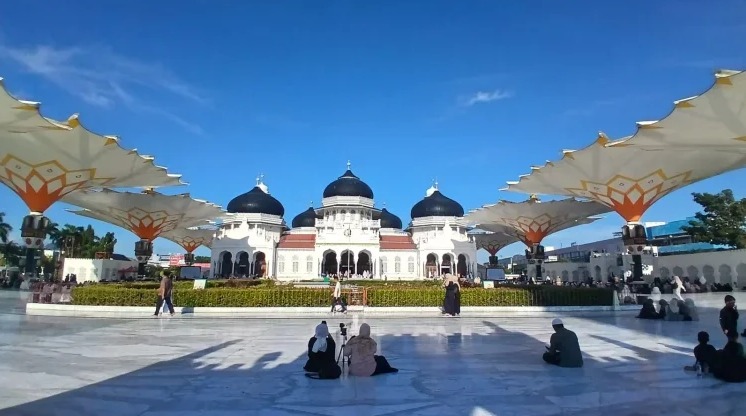
Baiturrahman Grand Mosque features architectural elements influenced by the Mughal style, evident in its domes, arches, minarets, and decorative details. The combination of a predominantly white exterior and black domes is one of its most recognizable features.
The mosque complex also has a spacious courtyard that accommodates worshippers. These architectural elements make Baiturrahman Grand Mosque one of the most prominent buildings in central Banda Aceh.
4. Giant Umbrellas in the Mosque Courtyard
In addition to the main building, the mosque courtyard features large umbrellas installed as part of the complex’s development. The umbrellas were installed as part of a site improvement project that began in 2015 and was inaugurated in 2017.
Its design was inspired by the retractable shade umbrellas at the Prophet’s Mosque in Medina, Saudi Arabia. They provide additional shaded space for worshippers, particularly during major religious gatherings when attendance increases.
5. Surviving from the 2004 Tsunami
The earthquake and tsunami that struck Aceh on December 26, 2004, marked a significant chapter in the modern history of Baiturrahman Grand Mosque. While several areas of Banda Aceh suffered extensive damage, the mosque remained standing with relatively limited damage.
The mosque complex also served as a temporary gathering place for survivors. The event reinforced the mosque’s status as a symbol of resilience for the people of Aceh and highlighted its role as a place where people could gather during an emergency.
Today, Baiturrahman Grand Mosque continues to serve as a major place of worship for Muslims and remains an important part of Aceh’s historical heritage. Its architecture and enduring presence reflect the region’s long journey from the sultanate era to modern times.
\\rri.co.id/en/tourism/2803302/baiturrahman-grand-mosque-acehs-historic-landmark